Table of Contents
Bidirectional charging (V2G) is becoming infrastructure in the US
Electricity demand in the U.S. is rising rapidly as electrification, data centers, and AI-driven computing place new pressures on the grid. “This convergence of grid stress and EV adoption is creating an accidental infrastructure revolution,” says Charged EVs, “but we see it as an opportunity for both automakers and EV charging operators.”
The aging U.S grid has reliability issues, too, particularly when there is bad weather. So there is also a need for additional forms of both distributed energy and backup power sources. Parked EVs are emerging as a practical option to support the instability.
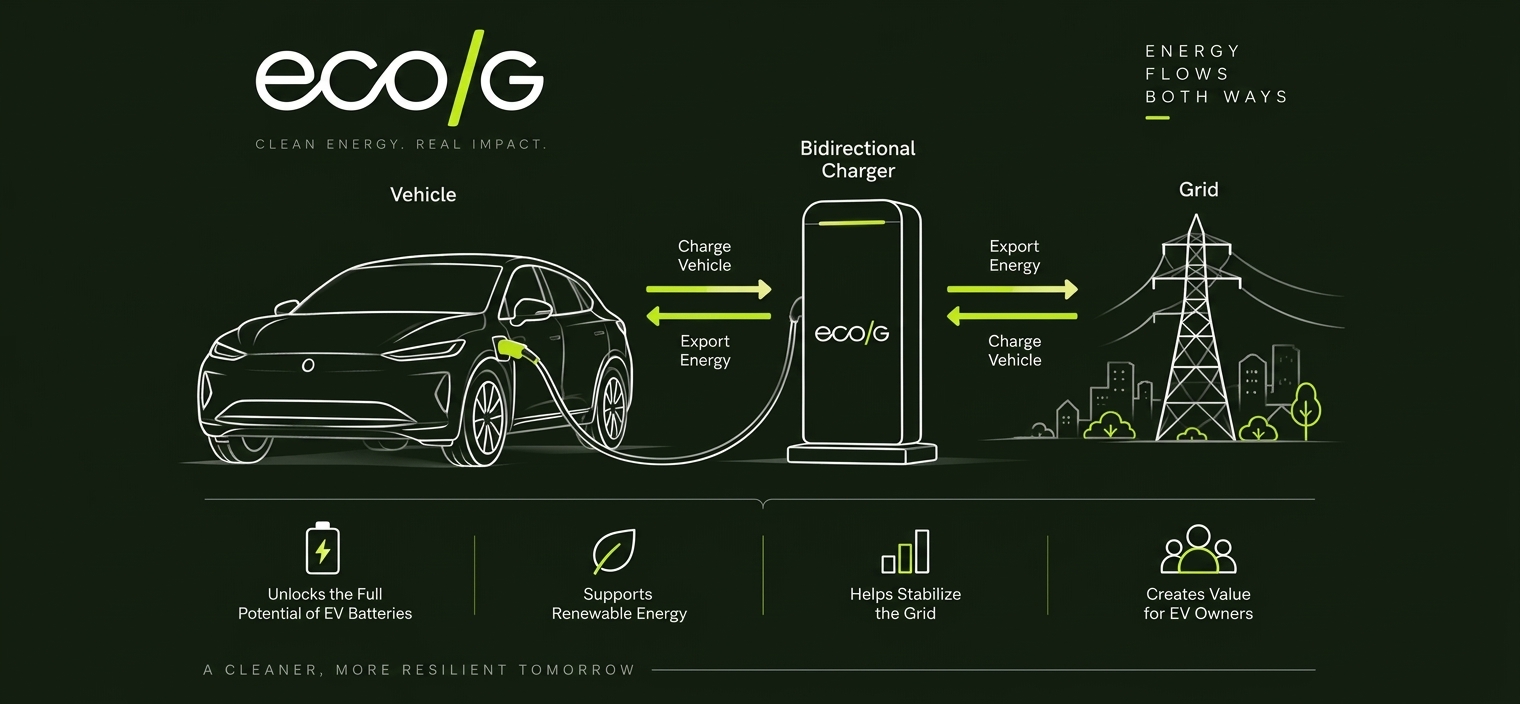
This is where bidirectional charging, also known as Vehicle to Grid (V2G), enters the conversation. Rather than functioning solely as transportation, EVs can act as distributed batteries capable of returning power to homes and to the electrical grid.
“A standard EV battery holds 60-100 kilowatt-hours of energy - enough to run an average American home for two to three days. Now imagine tapping into that reservoir when the grid is buckling under summer heat or winter storms,” notes Tech Buzz. “Automakers are racing to turn millions of EVs into distributed battery banks capable of feeding electricity back into … the grid itself. The technology, called bidirectional charging, is shifting from concept to reality.”
Tech developments, standards and the market are making the shift possible
What data tells us this is becoming a trend?
- Number of vehicle options: Back in 2022, there were only 15 car models that could accomplish at least one bidirectional charging mode, but now there are more than 75.
- The sheer quantity of EVs: Tech Buzz also did the math on the number of EVs in the United States, and it’s interesting to see the potential: 30 million EVs are expected on U.S. roads by 2023. “If just 10% of the[m] participate in vehicle-to-grid programs, that's 3 million mobile batteries providing flexible capacity exactly when and where it's needed. That's equivalent to building dozens of new power plants, but with zero construction time and [power] distributed across [specific] neighborhoods rather than concentrated in central facilities.” (1)
- Used EV sales are now up 34% in the southeast U.S. alone.
- The technology has advanced: The Clean Energy Review defines V2G this way: it “requires bidirectional power electronics [that are] capable of converting battery DC power into grid-compatible AC power, but those power electronics may be located either inside the vehicle or in an external bidirectional charger.” As bidirectional charging hardware matures and production volumes for EVs increase, manufacturers are beginning to invest more aggressively in the feature.
- Standardization and safety have evolved: Protocols such as ISO 15118-20 are becoming foundational for large-scale bidirectional charging because they enable secure communication and coordinated power flow. The leading safety standard is UL 9741, which provides the framework for V2G and V2X (Vehicle to Everything) applications.
The forecast for grid support via V2G
The network of chargers, and the infrastructure needed to support them, is also growing in the U.S., but quite slowly in comparison to many other countries. Part of the reason is that charging operators in the U.S. are struggling to reach their ROI because of the high cost of equipment, installation, and maintenance, and of course, the actual cost of electricity. However, chargers that can earn revenue from both charging EVs (with enough uptime and use) and sales of electricity to the grid could help.
Utilities in several states are beginning to conduct pilots to test and analyze how V2G will work for their communities. The top success stories so far come from a handful of cities using electric school buses. With their larger batteries, predictable schedules, and peak summer availability, each bus can earn up to $5,000 a year in V2G sales.
"Vehicle-to-grid technology isn't just a nice-to-have anymore. It's becoming critical infrastructure." - The Tech Buzz, July 2026
V2G could be the missing piece in the renewable energy puzzle. While wind and solar are cheap and battery installations smooth out supply, EVs offer instant, distributed storage that's already being purchased for other reasons.
EcoG can provide that missing piece - their complete ecosystem can potentially assist your organization to retain more uptime, and save or even earn money. Download our product catalog here to see more of what EcoG offers.
Sources for this article:
- EVs Become Grid Batteries as Bidirectional Charging Goes Mainstream
- US EV Fast Charging Station Utilization Rate Almost 16 Percent in Q2 2026
- Bidirectional EV Chargers Review - V2G & V2H — Clean Energy Reviews
- Charged EVs | Why EV charging is still such a hard business - Charged EVs
- Bidirectional EV Charging 2026: Complete V2G, V2H & V2L Guide | Which Cars Power Your Home & Grid? | Energy Solutions Intelligence
- What Does Growing EV Adoption Mean for the Distribution Grid? | LinkedIn